
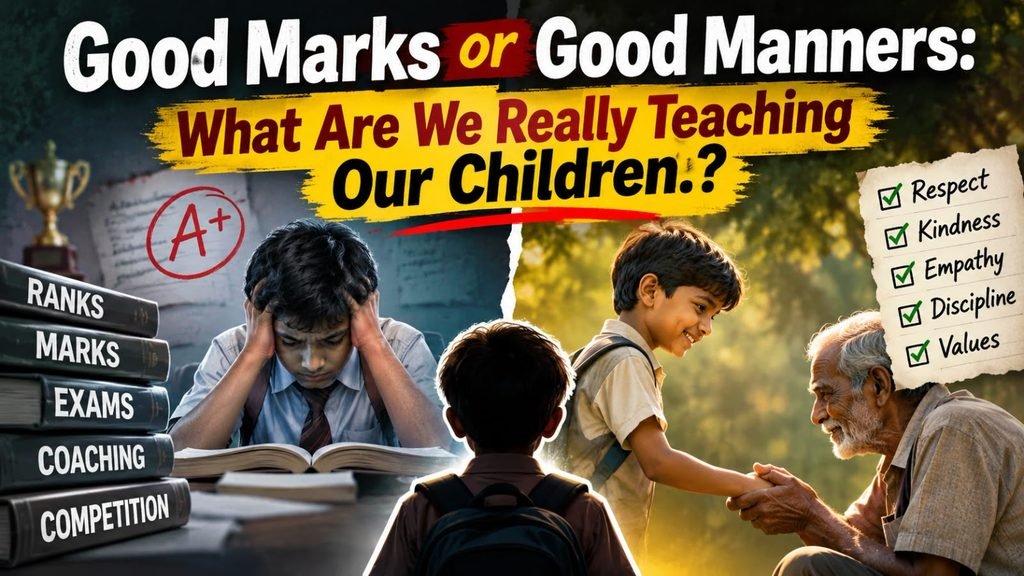
When we look at how parents raise children today, one important question comes to mind. Are we giving our children a bright future, or are we turning them into machines that chase high marks and top ranks? It is understandable that parents want their children to stay ahead in this competitive world. But in this race, are we slowly forgetting the importance of moral values, humanity and respect for others?
Recently, an incident at a school in Panchkula, Haryana, caused serious concern. An eight-year-old boy allegedly attacked a six-year-old girl, leaving her seriously injured. The incident, which took place on October 28, raised important questions about children’s safety, their behaviour, school supervision and the responsibility of adults in bringing up children.
Whenever such incidents happen, we discuss them for a few days and then forget about them when another news story comes along. This should not be the case. We need to ask ourselves how children are growing up, what is influencing their thoughts and behaviour, and how much responsibility parents, teachers and society are taking in shaping their future.
Why Do We Focus More on Education Than Values?
Today, education has become the biggest priority in a child’s life. Schools, tuition classes, special coaching, examinations and rankings are putting children under constant pressure from a very young age. If a child in the neighbourhood scores higher marks, parents expect their own children to score even more. Getting into a good college, finding a good job and earning a high salary have become the main measures of success.
But in this race, how much importance are we giving to the values that help children become good human beings?
Are we teaching them how to speak to others? How to understand other people’s feelings? How to control their anger? How to react when things do not go their way? How to accept their mistakes and correct them?
Scoring good marks is important, but developing a good personality is equally important. Education helps children move forward in life. However, respecting others, behaving responsibly and understanding the difference between right and wrong are what help them become good citizens.
Is Using Abusive Language Something to Be Proud Of?
These days, we often see children using abusive language at a very young age. Some use such words to look cool in front of their friends, while others do it just for fun. Sometimes, even adults laugh when children use bad language instead of correcting them. This can make children feel that such behaviour is perfectly normal.
Parents should pay attention to what their children are saying and how they are behaving with others. Shouting at or hitting children when they use inappropriate language is not the solution. Instead, parents should explain why such words are wrong and how they can hurt other people.
Giving children freedom is important. But freedom should come with responsibility. Children must understand from an early age that insulting, threatening or hurting others is not a sign of courage.
Treating Violence as Fun Is Dangerous!
Children fighting or getting angry is not something new. However, treating violence as normal or believing that hurting others is acceptable is a matter of serious concern.
Hitting someone, insulting them, threatening them or laughing at their pain is not fun. Children must understand that causing pain to others is wrong. They should learn that even when they are angry or when someone does not listen to them, violence is never the answer.
If children show serious aggressive or violent behaviour at a young age, parents should not simply dismiss it as childish mischief. Parents and teachers should try to understand the reasons behind such behaviour. If necessary, they should seek professional help. Instead of simply blaming children, it is important to guide them in the right direction and help them improve their behaviour.
Are Movies and OTT Platforms Influencing Children’s Minds?
Today’s children are spending more time watching television, using mobile phones, browsing social media and accessing OTT platforms. Although these platforms offer plenty of useful and educational content, they also contain violence, abusive language, scenes that insult others and content that sometimes presents bad behaviour as something admirable.
Children may sometimes imitate scenes in which movie heroes hit people, threaten others or use abusive language. However, movies do not influence every child in the same way. Family environment, friends, age and individual thinking also play an important role in shaping a child’s behaviour.
That is why parents should pay attention to what their children are watching and how they understand the content.
Parents should not only monitor the movies their children watch in theatres but also check the content they access on OTT platforms. They should pay special attention to movies and web series made for adult audiences. Parents should check age restrictions and content ratings and make use of parental control settings.
Giving children mobile phones for hours without knowing what they are watching is not a good practice. If a child sees inappropriate behaviour in a movie, parents should explain why it is wrong. Children must understand that movies are meant for entertainment and that they should not copy every action they see on screen in real life.
Give Children Freedom, but Teach Them Responsibility Too!
Supporting children every time they make a mistake is not the right approach. Just because they are our children does not mean everything they do is right. Such an attitude can create problems in the future. When children make mistakes, parents should have the courage to tell them that they are wrong. At the same time, they should create a home environment where children feel comfortable sharing their problems without fear.
Parents should spend some time with their children every day. They should talk about their friends, school experiences, interests and problems. When children share something, parents should listen patiently instead of immediately scolding them or passing judgment.
Children should learn how to express their feelings, control their anger and solve problems without using violence. These are important life lessons that should begin at home.
Most importantly, parents must lead by example. If adults insult others and use abusive language, telling children to speak politely will not make much difference. Children observe not only what we say but also what we do.
We Should Not Just Talk About Japan as an Example. We Should Raise Our Children the Same Way!
When people discuss children’s discipline, they often point to countries like Japan as examples. We appreciate the discipline, responsibility and cleanliness shown by children there. But simply praising other countries does not complete our responsibility.
We should also develop values such as discipline, cleanliness, punctuality, respect for others and responsibility in our children from an early age. They should learn that respecting elders is important, but so is treating younger children with kindness, respecting women, helping the weaker sections of society and apologizing when they make mistakes.
At the same time, parents and teachers should encourage children to ask questions and express their opinions respectfully. Discipline does not mean remaining silent out of fear. It means behaving responsibly without causing trouble or harm to others.
Is Raising Children Only the Responsibility of Parents?
Parents are not the only ones responsible for a child’s behaviour. Along with the family environment, friends, schools, society and media also influence children’s growth. Therefore, everyone should recognise their responsibility in shaping the future of children.
Schools should focus not only on education but also on teaching children how to manage their emotions, respect others, understand personal boundaries and avoid violence. When conflicts happen between children, schools should not simply ignore them as minor issues. Schools should inform parents whenever necessary and take appropriate action. School authorities must also supervise students properly to ensure their safety.
Similarly, when children show behavioural problems, parents and teachers should not label them or humiliate them in front of others. Instead, adults should try to understand the problem and find ways to correct their behaviour.
Humanity Is Just as Important as Marks!
There is nothing wrong with parents wanting their children to achieve great things in life. Every parent naturally wishes for their children to receive a good education, get a good job and become financially independent. But while working towards these goals, we should never ignore the development of their character and personality.
When children grow up, we should not measure their success only by how much money they earn. How they treat others, how they handle problems and how they correct their mistakes are equally important. A person who cannot understand the pain of others, control their anger or respect other people’s rights may find it difficult to become a truly good human being, no matter how educated they are.
Providing children with a good future does not simply mean sending them to expensive schools, arranging special coaching or giving them the best facilities. They also need love along with discipline, freedom along with responsibility, and good education along with strong values.
One final thought: Just as we feel proud when our children score good marks, we should take equal pride in raising them to become good human beings. What we need to give our children is not just a successful future, but also a life built on respect for others, responsibility and humanity.