
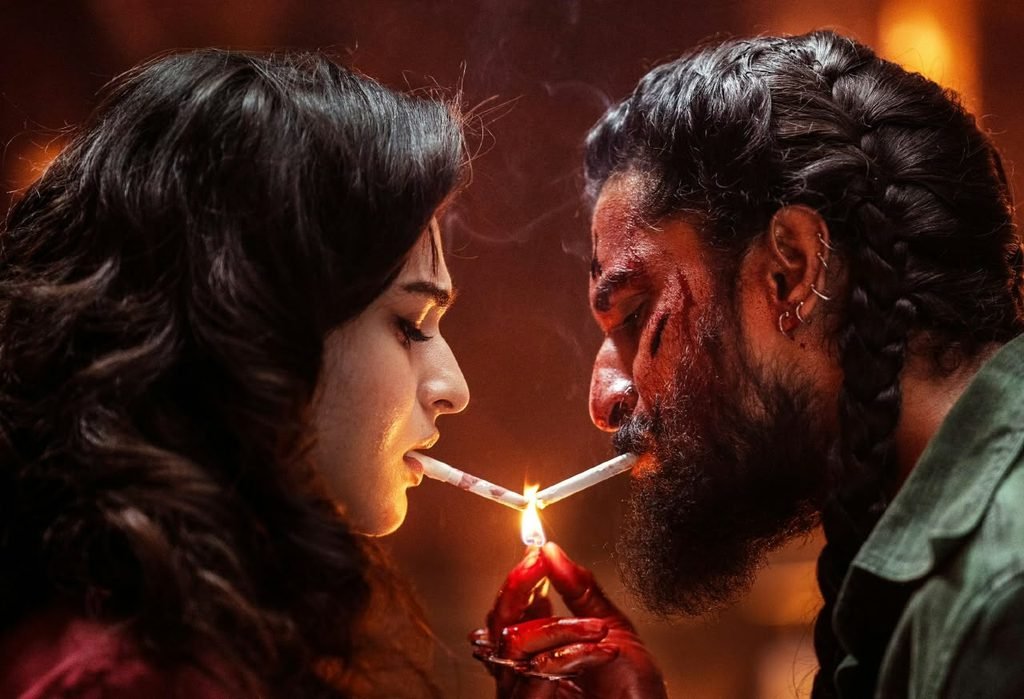
Nani and Srikanth Odela’s The Paradise created huge expectations right from the announcement. The promotional content created a lot of curiosity, especially with its violent visuals and raw world. The decision to release the movie without a trailer also worked well as a promotional strategy and made people even more curious.
With Nani coming in a completely different look and Anirudh handling the music, the expectations were high. But after watching the film, the biggest question is simple: Where is the actual movie?
Story
Set in the 1980s, the film takes place around the Paradise area near Secunderabad. A community called the Savaris has been living without proper recognition and has been treated badly for years.
Sammakka (Sonali Kulkarni) fights for the identity of her community. Her son Jadal (Nani), however, has grown up with hatred towards his mother because of an incident from his childhood. He believes that fighting the system through crime is the only way to get recognition. At the same time, Shikham Malik (Mohan Babu) controls the entire area and treats the Savaris badly.
Why does Jadal hate his mother? Why does Malik want to control the area? What happens to Sammakka’s fight for her community? To know the answers you have to watch movie on big screen.
Performances
Nani is decent in his role. He has definitely tried something different, but the character itself is not written strongly enough to make the performance create the desired impact. His fights and a few scenes work, but overall there is nothing extraordinary in the performance.
Kayadu Lohar has a limited role and does okay. Sampoornesh Babu is fine in a serious role, but even his character doesn’t get enough material. Mohan Babu has very little screen space and is just okay in the role. Raghav Juyal’s character has some potential, but the film doesn’t really use it properly.
Overall, the performances are just okay. Nobody can really save the film because the bigger problem is the writing itself.
Analysis
The biggest problem with The Paradise is that the movie simply doesn’t come together.
The film begins with an interesting setup. For a few minutes, you feel that the director is taking you into a completely different world. The setting is different, the characters are different and there is some curiosity about what is going to happen, But that feeling doesn’t last long.
Srikanth Odela had a strong idea and a completely different world in his hands, but the writing is extremely weak. The screenplay doesn’t have a proper flow. Scenes keep coming one after another, but there is very little emotional connection between them.
The first half has a few moments that create some impact. Anirudh’s BGM helps many of those scenes, and the interval block tries to give a big high. But when you look beyond the elevations, there isn’t much substance.
The second half is where the film completely loses its way. The film keeps trying to create emotion, violence and elevation, but none of it lands properly. Instead of making us care about the characters, the writing keeps pushing situations in front of us. After a point, you simply stop caring about what is happening.
This is where Srikanth Odela’s writing and direction become the biggest problems. The story has a serious subject, but the emotions are not properly developed. Characters don’t feel completely natural, and many scenes feel written only to take the story to the next elevation.
The film is also totally out of sync in many places. One scene feels like it belongs to one movie and the next scene suddenly takes the film in another direction. There is no smooth emotional flow.
The censor cuts make the situation even worse. In several places, the scenes feel incomplete, and you start wondering what exactly happened between two sequences. But even without those cuts, the writing itself has enough problems and the visuals are another disappointment.
Yes, there are a few good shots and some well-designed moments. But the majority of the visuals don’t look convincing. Most of the film depends heavily on sets, and many of those sets are clearly visible as sets. Instead of making us believe that this is a real world, the visuals often remind us that everything has been constructed for the film.
For a movie that depends so much on its world and atmosphere, that becomes a major problem.
The violence is also excessive, but violence alone cannot make a film interesting. Here, a lot of it feels unnecessary because the writing doesn’t give those moments enough weight.
The foul language is also used heavily. Again, it could have worked if it was naturally part of the world, but here it often feels forced.
Anirudh’s BGM is one of the few things that works in parts, especially during elevation scenes. But even there, the music sometimes becomes so loud that it dominates the dialogues. Instead of making certain scenes better, it sometimes hides the weakness of the scene.
The cinematography has some good work, but overall the visual presentation is inconsistent. The production values are clearly high, but spending heavily on a film doesn’t automatically make the scenes effective.
The biggest disappointment is that the film had everything needed to work on paper. A strong actor, a director who already delivered a successful film, a unique world, a big technical team and huge expectations.
But the writing needed to be much stronger.
The Paradise tries very hard to look like a big, raw and violent film. But underneath all that, the actual story and emotions are extremely weak.
Verdict
The Paradise is a major disappointment. Weak writing, poor execution and a completely out of sync screenplay make the film a frustrating watch. The visuals and performances are just okay, but nothing really works as a whole. A big miss.
Rating: 1/5